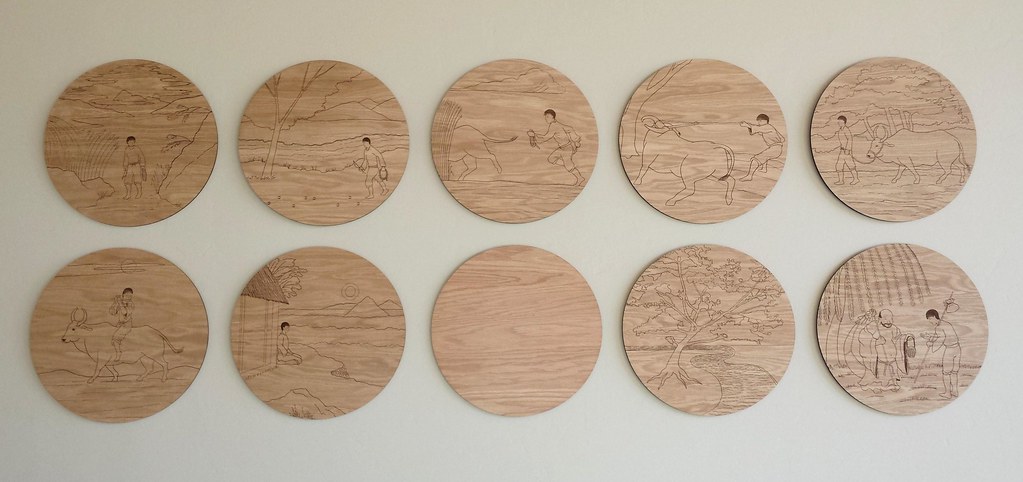
In the vast landscape of Buddhist teachings, few stories are as visually striking, symbolically rich, and profoundly personal as the Ten Ox-Herding Pictures. Originating in the Chan (Zen) Buddhist tradition in China and later flourishing in Japanese Zen, these ten images depict the spiritual seeker’s path from confusion to awakening—and ultimately to compassionate action in the world.
Though centuries old, the story remains timeless because it maps the inner journey that countless people still experience today: the search for meaning, the struggle with the restless mind, the discovery of clarity, and the return to everyday life with wisdom and love.
Let’s walk through the story and its deeper meaning.
1. Searching for the Ox
The seeker wanders through tangled forests and winding rivers, feeling lost and disconnected.
Meaning:
The “ox” symbolizes our true nature—our innate clarity, compassion, and freedom. The search represents the moment we recognize that something essential is missing. Life feels fragmented, and we yearn for truth.
2. Seeing the Footprints
The seeker discovers traces of the ox in the mud.
Meaning:
These footprints could be teachings, insights from meditation, or sudden glimpses of inner stillness. Something confirms that the path is real. Hope appears.
3. First Sight of the Ox
The seeker finally catches a glimpse of the ox’s form.
Meaning:
We begin to see our mind clearly—its patterns, illusions, and deeper potential. This stage is often joyful but fragile.
4. Catching the Ox
A struggle ensues. The ox resists capture, and the seeker strains with all their strength.
Meaning:
Training the mind is difficult. Old habits fight back. Meditation feels chaotic. The ego resists surrender. This is discipline, grit, and perseverance.
5. Taming the Ox
The ox slowly becomes calm under the rope and whip.
Meaning:
With steady practice, the mind becomes more peaceful and stable. The seeker discovers trust, patience, and a quiet confidence.
6. Riding the Ox Home
The seeker rides the ox while playing a flute, serene and carefree.
Meaning:
Harmony arises. The seeker no longer battles the mind; they flow with it. Life becomes simpler, less anxious, more authentic.
7. The Ox Transcended
Both ox and rope disappear.
Meaning:
The symbol of the ox is no longer needed. The seeker’s true nature is recognized as inseparable from everything. There is no longer a sense of division between “self” and “world.”
8. Both Ox and Self Forgotten
An empty circle.
Meaning:
Deep, nondual realization. Even the idea of enlightenment dissolves. Pure presence remains—beyond concepts, beyond striving.
9. Returning to the Source
The seeker sits by a river or a tree, utterly at ease.
Meaning:
Life is simple again. Nothing mystical—just reality, fresh and unobscured. Enlightenment is revealed as utterly ordinary.
10. Entering the Marketplace with Helping Hands
The final image shows the seeker—now often depicted as a jolly, barefoot figure—returning to the busy world.
Meaning:
This is the heart of the teaching. True awakening is not isolation from the world but compassionate engagement with it. The enlightened person helps others without preaching or pretension, bringing wisdom into the marketplace, into families, workplaces, and communities. Enlightenment becomes embodied kindness.
Why This Story Matters Today
The Ten Ox-Herding Pictures remind us:
- The spiritual journey is not linear—we move back and forth between stages.
- Awakening is not escape—it is coming home to ourselves and returning to the world with open hands.
- You don’t have to “destroy” the mind—you learn to understand it, train it, and eventually transcend the illusion of separation.
- The end of the path looks very normal—but the normal becomes radiant.
Ultimately, the story teaches that the deepest realization isn’t found in mountaintop isolation but in everyday life: washing dishes, talking with a friend, helping a stranger, listening deeply, showing up with presence. Enlightenment becomes action, compassion, and community.
 Rainbow Lotus Brand Blog
Leave a comment